Full Mouth (Arch) Replacement Options in Northern Kentucky & Cincinnati, OH
If you are missing all of your teeth, or will soon need the rest of your teeth removed, there are 4 main options to consider when it comes to replacing them. The first option is to do nothing and simply not replace them at all. While this is an option it is not one we recommend as teeth offer many quality of life benefits including improved chewing and digestion, proper nutrition, better speech and communication as well as improved facial structure, esthetics and smile which improve mental health and self-esteem.
If you decide you would like to replace your missing teeth, the 3 main options are a conventional complete denture, Implant or Tooth Supported Overdentures or a fixed full-arch prosthetic commonly referred to as an all-on-x procedure.
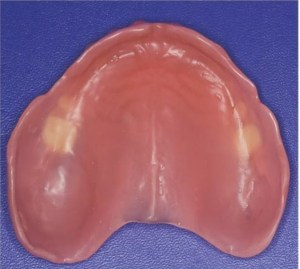
Traditional Complete Denture:
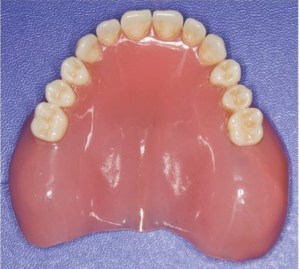
Before the advent of implants and overdentures, these were the main option available for replacing teeth and for some can still be a good option. These dentures are made by creating a custom fitted prosthesis to fit over your gums and jaw bone that is taken out and removed each night. They are retained by suction alone and often need some form of glue or adhesive to help them stay in place. They can offer a nice esthetic result. The main complaints of this form of replacement are they feel big and bulky, are hard to keep in place (especially on the lower jaw) and tough to chew with. Conventional Dentures offer significantly lower biting forces, about 25-55N, which is roughly one-sixth that of natural teeth. When it comes to chewing, this option is the least efficient, creating the lowest bite force and requiring the highest number of chewing strokes to breakdown food.
Implant or Tooth-Supported Overdentures:
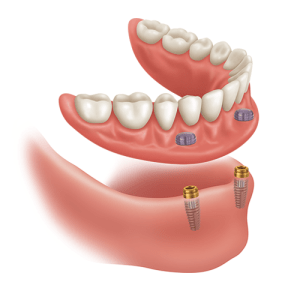 Overdentures build on the design and benefits of conventional dentures by trying to address the main complaints with conventional: poor chewing ability and loose dentures. Overdentures use either implants or the healthy roots of remaining teeth to hold onto abutments that the denture base can snap into. The denture material still wraps over your existing gums and jaw bone but use suction AND the abutments to retain the denture. Overdenture’s increase biting force by almost double! At a biting force of ~60-130N overdentures can reduce food particle size by 75% and they require almost 30 less chewing strokes to create the same particle size as a conventional denture. Patient satisfaction is typically much more with Overdentures compared to Conventional. These dentures still need to be removed every night.
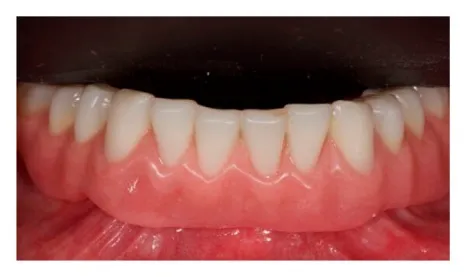
Fixed Full-Arch (All-On-X) Prosthesis:
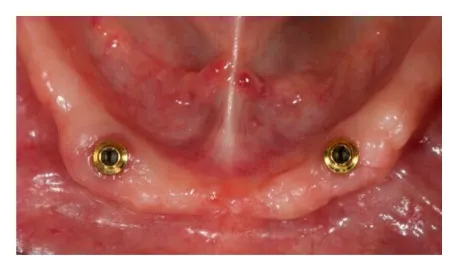
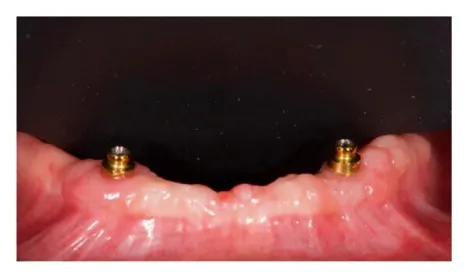
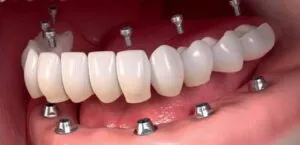
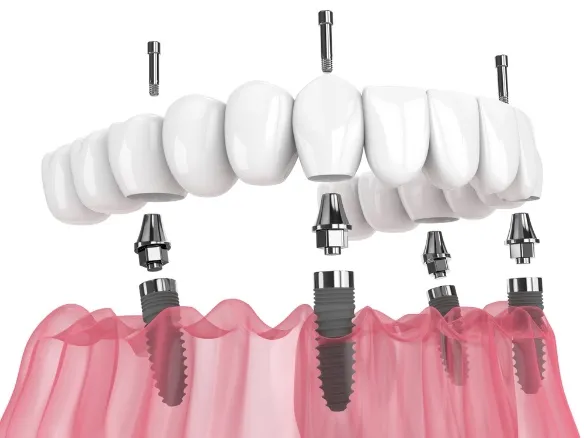
Fixed Full-Arch dentures are the closest solution we have to natural teeth. They offer the highest bite force, chewing efficiency and stability. They function by being screwed onto 4 or more implants, directly supported and retained by the implants alone. These do not need to be taken out every night! You need to brush and floss (waterpik is recommended) just like natural teeth and once a year we may remove them for you to clean around the implants and then simply screw them back on. Patients with a fixed full-arch solution show the highest patient satisfaction in regards to chewing function, stability and esthetics.
Traditional (Conventional) Dentures
- Fully removable acrylic prosthesis resting directly on the gums.
- Stability relies on suction and adhesives, with potential slipping—especially lower dentures—and risk of gum irritation and bone loss over time
Implant-Supported Overdentures
- Removable denture that “snaps” onto 2–4 implants (or retained natural roots).
- Offers enhanced stability, retention, improved chewing, and helps preserve bone structure compared to conventional dentures
Fixed Full-Arch Dentures (e.g., All‑on‑X)
- Permanently fixed prosthesis anchored by 4+ dental implants; only removed by a dentist.
- Provides the highest bite force, chewing capability, and resembles natural teeth most closely
All 3 of these options still have their place in dentistry when it comes to replacing a full arch of missing teeth. We are happy to set up an appointment to discuss all 3 options and determine which one is best for you! If you currently have conventional dentures and are dissatisfied with the fit and/or function, we are happy to discuss the conversion process to turn it into one of the other 2 options above.
|
Prosthesis Type |
Bite Force (mandible) |
Chewing Efficiency |
Notable Pros & Cons |
|
Conventional Denture |
~25–55 N |
Poor—~69 strokes to chew |
Low stability, low force |
|
Implant Overdenture |
~60 → ~132 N |
~76% smaller particles, ~40 strokes |
Much improved over traditional |
|
Fixed Full‑Arch (All‑on‑X) |
~209–219 N |
Highest efficiency |
Best for force & stability |
Ready to Schedule a Consultation?
Drs. Stewart or Mettens offers a number of dental treatments that can keep your mouth healthy and your smile beautiful. Contact us today!